How beautiful it is!
Versão em Português
The Report
Our noisy neighbours were leaving that morning - what a relief! Taking advantage of the proximity to a bakery, I bought yoghurt for breakfast and mineral water for the tours.
We left Ygarapé at 8am, following another car that was taking the guide Osmar. About half an hour later, always mostly on unpaved road, we arrived at the reception of Gruta do Lago Azul (Blue Lake Grotto), the only tourist attraction under governmental responsability - the rest are in private properties. There is a limited number of visitors per day, in groups of a maximum of 12 people plus a local guide.
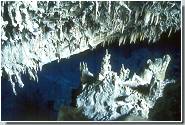
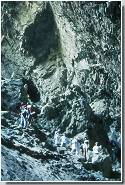 We began the tour at 9am, with the guide Jagles. After a short trail, we reached the entrance of the grotto, protected by bars. Then we began the descent, to a depth of 180m. The path is not difficult, soothed by stops to observe the formations. The cave is around 500 to 600 million years old! The grotto was discovered by a native in 1924 and nominated a National Heritage in 1978. Opened to the public a few years later, it became a symbol of Bonito.
The blue colour of the lake is really impressive and is due to the presence of calcium and magnesium in the water - which happens in all the region and makes the water unproper for drinking.  The greatest depth in the lake is 55m and two minuscule species inhabit it: a 0,7mm and a 1cm worm. Prehistoric fossils of a giant sloth and a sabre-tooth tiger have been found there. During the month of December, sunrays reach the surface of the lake. Visitation then is very busy - we were told that for this year almost all scheduled tours are fully booked. Anyway, it is important to check the best times - in our case, the tours starting the descent between 9 and 10am, according to what we were told.
We were lucky that, due to the rythm of the other groups, we were able to stay a long time at the closest point to the lake we are allowed - we cannot get to its surface. The tour takes a total of two hours, 90min of which in the grotto itself. We left the site before 11:30, in time to eat something downtown. I went try the baked icecream: fruit salad with icecream and chocolate sauce, topped with chantilly and taken into an oven. Only the chantilly gets hot, very good.
I rented an underwater Canon camera for a trial, as I always use disposable ones. The result, later I verified, was medium - some photos turned out good, others not so much, and it was not possible to assert whether it is better than a disposable, but maybe it is also a matter of practice.
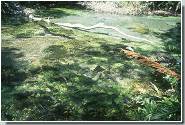 We left at 12:30 to Sucuri River, circa 40min away. We found the guide Lyglauber there and I think we were seven doing this tour. The equipment is included, except for the wetsuit, but it can be rented there. We leave the car at the tour end, then a light truck takes us to be head of a 600m trail, along which we see trees and the river springs. Then we go inside a small boat to traverse the first 500m, because of the very shallow water depth at the spring, and after that we enter the water to start the 1500m downriver flotation. The boat follows us, carrying some personal items (cameras, sandals, glasses).
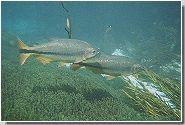 This time, besides the fish we had seen at the Natural Acquarium, we also saw lambaris and cascudos, but the underwater vegetation is notewhorty. However, I believe the vegetation is the reason why visibility decreases so much towards the end of the tour. Flotation there lasted less than one hour. It could have lasted more, if people only let themselves be carried by the stream. After we removed the equipment and dried up, we returned to the reception, where a revigorating hot chocolate waited for us. We were told that the best tour times are early in the afternoon, like we did.
At 4pm we were back in town. As we still had two days without any programmed tours, we studied the options, trying to reach an agreement. The problem is that some tours are alike. There was a possibility of trying to visit Bodoquena, which is said to be a new Bonito. But we decided nothing.
We had dinner at Aquário, where Kátia and Ernani had ordered pintado na telha, a typical dish fish cooked on tiles that has to be ordered at least one hour in advance. I had a swiss steak (with a melted cheese sauce, very good). As usual, there was too much food. And once again, we had icecream afterwards.
Day 5 - "Today was the day of the famous Rio da Prata tour. Excelent, except for the lack of sun, that only returned late in the afternoon."
We woke up early. It was just past 7:30 when we left Ygarapé with the guide Marcelo, one of the most experienced, graduated in the first guide training course five years ago. In our group, there was also a nice couple from Campo Grande, Gerusa e Eduardo, which would be returning home from there. The weather was not good, remaing cloudy most of the day. On the way, Marcelo told us a lot about tourism in Bonito. For this year, there would be around 50 thousand Brazilian visitors and 20 thousand foreigners, a proportion that surprised us.
The Recanto Ecológico Rio da Prata (Prata River Ecological Retreat) is 54km from Bonito. It took us slightly over one hour to get there, on a dirt road that was very bad in some points. We got the gear, included in the price. I did not use the vest this time, as I had noticed that the wetsuit gives enough flotation.
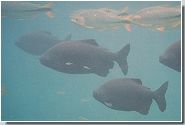 We went by car near the place where the tour ends. There is no support boat, so we leave near the river all we are going to need when we get out of water (towel, shirt, sandals). We swim a bit there at Prata River, where we could see big pacus, besides the omnipresent piraputangas and curimbatás. Water there was a bit turbid.
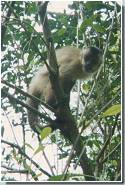 Then we started a 2km walk in the woods, near the river. The vegetation was already familiar to us. A curious tree is the figueira mata-pau (timber-killer fig tree), which leans in general on the bacuris, embrancing it with its branches. Some say it kills its host with its embrace, others say it kills by sucking all nutrients from the soil. Many macacos-prego (capuchin monkeys) appear in the way and the guide always have some corn for them. They are cute.
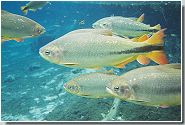
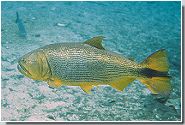
After about 50min walking and a few mosquito attacks, we arrived at the spring of Rio Olho d'Água (Olho d'Água River), a tributary of Prata River, where we would make most of the flotation - from the roughly two hours in the water, only circa the last 20min are in Prata River. The spring is almost a pool teeming with fish, where in some places we see water sprouting from the bottom, through a hole or bubbling through the sand, all due to the permeability of the limestone. Besides all the fish we already knew, we saw a tiny red fish called mato-grosso and, quite hidden, a pintado or maybe its relative cachara (they look alike). We remained for about 20 minutes, maybe more, at the spring. The we started to follow the stream.
 |
 |
As the water level was low, we often had to divert from trunks and branches. At a point with rapids, we did a detour on land. Mosquitos were ready to attack us. There is another rapid that we go by in water, it is not dangerous. Soon after we stopped on a platform to see the "volcano", a huge resurgence, which is how the emergence of water are called. The depth at this point is bigger, but those who can dive - I can't - can get near the volcano, and even hear its sound. While we took a break at the platform, fish bit us! But they don't hurt, it's only unpleasant.
Soon after that, we came Prata River, where we were greeted by pacus, which don't swim far into Olho d'Água. The difference between the two rivers is not only in turbidity - Prata River is colder and the stream is weaker, forcing us to swim, which was tiring. Those who wish can skip this part and go back through the trail, but we all continued. Later, while we were drying up, the next group arrived, telling us they had seen a sucuri (anaconda) - how I envy them! Marcelo had been trying to find it, without telling us.
After so much excercise, lunch was welcomed. Not that the dishes were attractive to me, but I was hungry. There was the famous sopa paraguaia (Paraguayan soup), a typical dish that is more or less a corn souffle. What is really good was the milk sweet, delicious! After lunch, we rested a while in leather hammocks. On busier days, it may be difficult to find a free hammock...
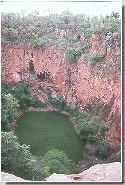 We left at about 3pm and went to Buraco das Araras (Macaw's Hole), a crater about 120m deep, created by the wear of the limestone of its bottom, which is carried away by underwater rivers, making the soil above give way. This is a "pseudo-doline", because the upper soil is sandstone. A true "doline" is formed only by limestone. We have to pay a small fee, R$2 per person, to go near it and circle it. This is one of the places in the region for rappelling. Its name derives from the red macaws that used to live there. Today bats mostly inhabit it, leaving in flocks at night. The Hole has a tragic past, though: many people were killed and thrown into it, so their bodies would not be found. There is also a car down there, believed to have been thrown by its owner in order to receive an insurance.
Back in town past 5pm, I returned the rental camera and had the films developed. We had dinner at Tapera, where Kátia and Ernani had a stuffed pacu (which has to be ordered one day in advance), while I had a steak with salad and mashed potatoes. Even with a full stomach, we tried another icecream shop, at the main square, but their icecream wasn't so good.
Versão em Português
|
text and photos © Maria Adelaide Silva - no reproduction is allowed without the author's agreement | ||
 Comments? Suggestions? Send me a message! Comments? Suggestions? Send me a message!Visit Adelaide's Home Page |
Last updated on 4/12/1999 © Maria Adelaide Silva |
|