

Chester
| Chester is an ancient city in northwestern England, famous for its almost intact walls, built and rebuilt during the centuries since Roman times, about 2000 years ago, when it was called Deva. Chester, located by the river Dee, used to be an important port until the 18th century, when it silted up. |
|
|
|
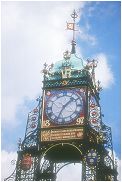
The Eastgate Clock decorates Chester most famous' gateway and it's said to be the world's second most photographed clock (the Big Ben, of course, it's number one). It was erected to celebrate 60 years of Queen Victoria's rule in 1897. The view from Eastgate gives a glimpse of the well preserved city center and it's a good starting point to the walk along the famous walls. | |
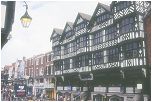
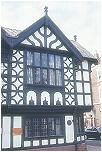
| Maybe all of Chester's medieval black and white halftimbered buildings, many of which are reproductions of original houses, are nowadays shops and restaurants. |
|
|
| At the main streets - Eastgate, Bridge, Northgate and Watergate - one finds the charming two-tiered galleries of shops called "The Rows". The area where these four streets meet is called the Cross. A favourite attraction for visitors is the regular appearance of the Town Crier, a character in medieval costume who greets visitors everyday at noon, and the many street artists. | ||
|
Stanley Palace, at Watergate Street, is one of the city's most ancient historic buildings, dating back to 1591. This beautiful Tudor building was the home of the Earls of Derby. | |
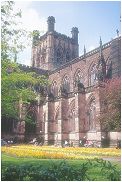
| Chester Cathedral was built in the 13th century, over the site of a Benedictine Abbey founded in 1092, which by its turn had replaced a Saxon church from the 10th century dedicated to Saint Werburgh. It became a Cathedral Church of Christ and the Blessed Virgin Mary by Henry VIII in 1541. Some of the abbey's original Norman architecture survives today. |
|
|
|
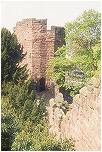
The walls surrounding Chester, about 3km long, offer an easy and pleasant walk with views of the city and some of the Roman sites, such as the amphitheater - the largest stone-built one found in Britain (it could hold 7000 spectators). | |
| The wall's western portion is partially lost and the city itself in not so well preserved in this area, but the rest of it is definitely worth visiting. The walls, with some parts built by the Romans and later enlarged by Vikings and Normans, have signposts with details about it. | ||
| The Town Hall, a Victorian Gothic building of red and grey sandstone, was built in the 1860's. Its tower is 160ft high. In the Waiting Hall, the Chester Tapestry is on display: woven in 1975, it depicts the river Dee and the city's landmarks. Next to it there was a Market Hall, now demolished, and beneath it many Roman artifacts have been found. |
|
|
|
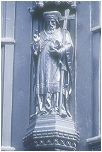
A sculpture at the façade of a house. | |


Chester.com
Visiting Chester, by Chester City Council
Chester: a virtual stroll around the wall
Copyright © Maria Adelaide Silva
No reproduction is allowed without the author's agreement