

Petra
 |
Petra, 260km south of Amman, is probably the best known attraction of Jordan. To reach the old capital of the Nabateans - arab bedouins who settled in the area on the 4th century BC - you cross the Siq, which is a narrow natural passage in the colorful sandstone. |
| At the end of the Siq, you find Petra's most famous site - the Treasury or al-Khaznah. Carved in the rose red sandstone, it is 40m high and 28m wide, and has a few chambers inside (but not deep into the rocks like in the Indiana Jones movie). The Nabateans left no written records, and so its use is yet unknown. Most scholars believe it was built as a mausoleum or a temple, as the lack of ventilation would not allow people to live inside it. |  |
 |
Protected from the wind, its façade decorated with high reliefs is very well preserved. It is believed that the Treasury was built around 2000 years ago. |
| Further into the valley, you find carved dwellings and tombs. Most of the site hasn't been excavated yet. Petra means "stone" in Greek. | |
 |
 Rock colors are truly amazing. Above is a detail of the chamber at left. |
 |
Some of the buildings are on the hills overlooking the valley, like this series of royal tombs. One of them, known as the Silk Tomb, has a striking façade because the sandstone has layers of many different shades red, white, yellow and blue. |
| Visitors that take a day tour to Petra like I did often miss some of the other attractions on the hills, like the Monastery or ad-Deir and the cisterns at Um al Biyara. Climbs there are often tiring. | |
| The Nabateans built water dams, channels and cisterns. Caravans knew they would find water, food and protection there. Petra thus became a crossroads and a thriving commercial city. Not surprisingly, the Romans conquered the area around 68 AD and later came the Byzantines. | 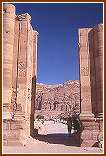 |
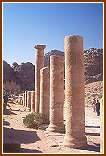 |
The Romans left their own legacy in the area, with paved roads, arches, columns and an amphitheater. Petra was nominated a World Heritage Site by UNESCO in 1985. |
| After its decline Petra was forgotten for centuries, its location known only by local bedouins. But in 1812, Johann Ludwig Burckhardt, a Swiss explorer disguised as an Arab pilgrim, managed to be taken to the area and the lost city of Petra was revealed to the rest of the world. | |
Jordan Travelogue - Petra, by Patrick Wullaert
Petra, by Petra Moon Tourism
Petra, by @AtlasTours.Net
Copyright © Maria Adelaide Silva
No reproduction is allowed without the author's agreement