

Antwerp
|
|||||||||
| The Grote Markt (Great Market) was the center of the old section of Antwerp. Most of its buildings are from the 15th and 16th centuries, a wealthy period when Antwerp was one of Europe's most important commercial and financial centers. These buildings - some of which reconstructed in the 19th century - of Flemish-style façades are decorated with gold-gilded statues. They belonged to the corporations (guilds) of that time. | |||||||||
| The Stadhuis (town hall), located at Grote Markt was built in the 16th century in an Italian-Flemish renaissance style. In front of it there is the statue of Brabo, the city hero. According to legend, the giant Antigoon used to collect a toll from those entering the port of Antwerp and would cut off the hand of those who could not pay. Brabo challenged and defeated Antigoon, cutting off his hand and throwing it into the river. This is the origin of the city's name: Antwerp means "throw a hand". |
|
||||||||
|
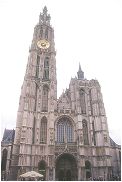
The imposing Cathedral of Our Lady, with its high ceilings and beautiful stained windows, was built along the 14th to 16th centuries, over an ancient roman church whose remains can be seen underground. Its tower is over 120m tall; a second one was planned but never built. The church itself was planned to be three times bigger, in a demonstration of the city's power and wealth. | ||||||||
| The church's works of art were lost during the many episodes that took place, such as the Calvinist reform and the French invasion, but today some of these treasures have been returned. Some of Rubens' works can be seen in the cathedral: "The Descent from the Cross", "The Elevation of the Cross" and "The Assumption of the Virgin Mary", all from early 17th century. | |||||||||
| Saint Paul's Church is a magnificent barroque church with beautiful wood carvings, altars and paintings, including some by Rubens, Van Dyck and Jordaens. Outside there is a lovely sculpture garden. |
|
||||||||
|
Located by Scheldt River, Steen is one of Europe's oldest fortresses, originally built in the 10th century and rebuilt in the 16th century. Now it houses the National Maritime Museum. | ||||||||
| The famous painter Pieter Paul Rubens was born in Germany, but his parents were from Antwerp and he lived there is his youth before going to study and work in Italy. When he returned, he became the court's favourite painter. He designed and built his house, Rubenshuis, now a museum honoring the master. |
|
||||||||
|
|||||||||
| One of the loveliest aspects of Antwerp for me are the charming narrow streets, courtyards and stone buildings that can are found around the Grote Markt. | |||||||||
| Antwerp nowadays is the world's most important diamond trading center. It is possible to see diamond cutters in action at Diamondland or visit the Diamond Museum, which shows how diamonds are produced from mining to cutting and also displays some beautiful diamonds. | |||||||||




City of Antwerp
Visit Antwerp
Welcome to Flanders
Copyright © Maria Adelaide Silva
No reproduction is allowed without the author's agreement